Goat breed
Anglo-Nubian
Anglo-Nubian
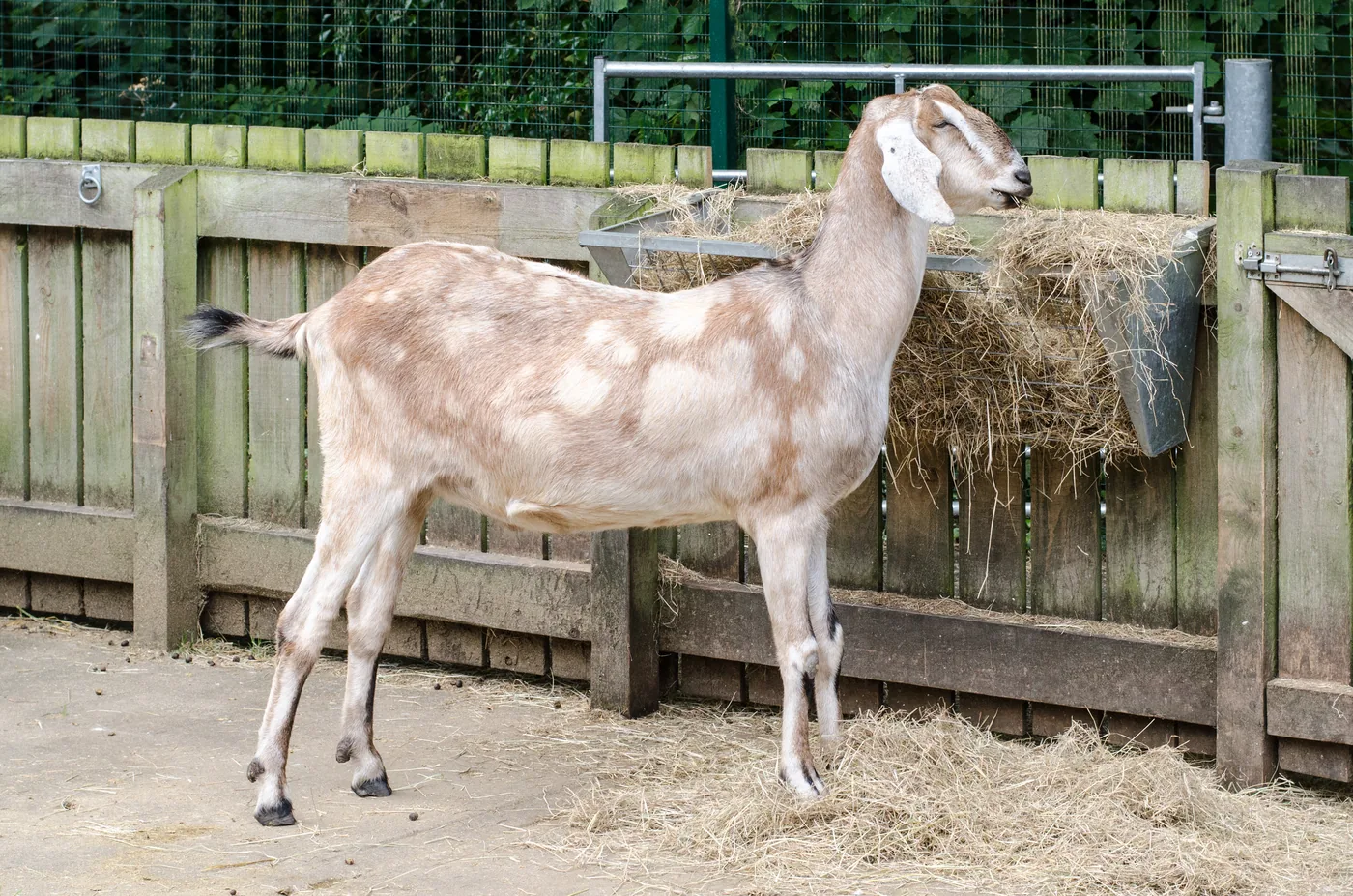
An English milk-and-meat goat with Egyptian and Indian buck blood: long pendulous ears, Roman nose, high-fat milk.
Anglo-Nubian goat. Photo: „Anglo-Nubian goat” – arseni.mourzenko · CC BY 2.0 · Flickr · Resized and converted to WebP
Description1
A dual-purpose (milk and meat) breed developed by crossing Zaraibi (Egypt) and Jamnapari (India) bucks with English dairy goats. It is known for its friendly, even temperament.
Because of its high environmental and feeding requirements it is best kept intensively; first breeding is at 10–12 months. Average milk yield is 400–600 kg, up to 1000 kg in a 300-day lactation; the milk has 4–5% fat and 3–4% protein.
Its appearance is defined by long legs, a large body, broad pendulous ears longer than the nose, and a short coat. The head is short with a Roman nose; some animals are bearded. The udder is hemispherical and well attached.
Breed standard and breed society
The official breed description, breeding goal and herdbook rules are published by the recognised breed society (MJKSZ).
- MJKSZ – Anglo-núbiai kecske fajtaleíráshttps://mjksz.hu/tenyesztes/fajtak/anglo-nubiai-kecske
- NÉBIH – Elismert tenyésztő szervezetek fajtanyilvántartója (2026. 10. 15.)https://portal.nebih.gov.hu/documents/10182/379191/Honlapra_NEBIH+fajtanyilvantarto.pdf/b9c77093-8ccb-1547-b870-e676112487d8?t=1781163930044
Photo gallery
All photos are freely licensed (Wikimedia Commons, Flickr); author, source and licence are shown under each image.
Sources
- MJKSZ – Anglo-núbiai kecske fajtaleírás
- NÉBIH – Elismert tenyésztő szervezetek fajtanyilvántartója (2026. 10. 15.)
Accessed: 2026-10-18.